
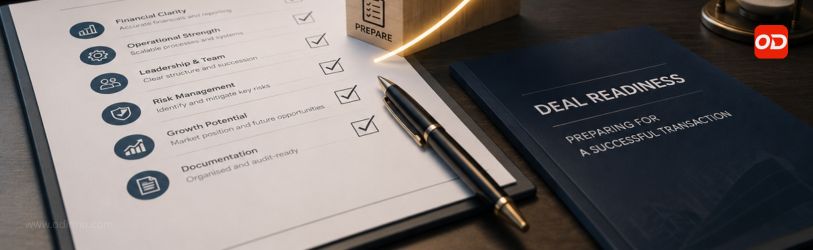
Many SME owners believe they are closer to a transaction than they really are.
✔ Revenue is growing.
✔ Financials are healthy.
✔ Buyer interest exists.
✔ The business appears stable.
From the outside, the company may look ready for market.
But transaction readiness is rarely determined by surface performance alone.
For advisors managing client expectations around exits, acquisitions or succession planning, one reality becomes clear very quickly: most businesses underestimate how much preparation is required before a process should begin.
True SME transaction readiness involves far more than assembling financial documents. It requires operational clarity, risk visibility, leadership stability and the ability to withstand buyer scrutiny under pressure.
And achieving that takes time.
“Deal Ready” Means More Than Financially Prepared
Many owners associate preparing a business for sale with valuation work, tax structuring or financial housekeeping.
Those elements matter.
But buyers assess much more than numbers.
A business becomes genuinely deal ready when buyers can see:
- Operational stability
- Leadership continuity
- Scalable delivery capability
- Clear accountability structures
- Reliable reporting systems
- Reduced dependency risks
- Consistent strategic execution
- Organised due diligence preparation
In practice, many transaction delays happen because operational readiness has not kept pace with commercial growth.
The business performs well day-to-day, but once external scrutiny begins, weaknesses emerge that were previously manageable internally.
That is where timelines begin extending unexpectedly.
👉 Read more: Recommendations Don’t Change Businesses. Operators Do.
Why SME Transaction Readiness Often Takes Longer Than Expected
Owners commonly assume transaction preparation takes weeks.
In reality, meaningful sell-side preparation often takes several months and in some cases longer – depending on the maturity of the business.
That is because preparation involves more than collecting documents.
It often includes:
- Improving operational visibility
- Clarifying management responsibilities
- Reducing founder dependency
- Addressing process inconsistencies
- Organising reporting structures
- Resolving hidden operational inefficiencies
- Identifying pre-transaction risks
- Strengthening internal accountability
Many of these issues cannot be solved instantly because they are embedded within daily operations.
Advisors understand this well.
Operational weaknesses that appear small internally can become significant concerns during diligence.
The earlier they are addressed, the smoother the transaction process becomes later.
The Difference Between Financial Readiness and Operational Readiness
A business may be financially successful while still carrying substantial operational risk.
This distinction matters heavily during due diligence preparation.
Buyers evaluate whether the business can continue performing predictably after ownership changes. That assessment goes beyond revenue and EBITDA.
They want confidence in:
- Leadership depth
- Operational resilience
- Process maturity
- Customer continuity
- Reporting reliability
- Team structure
- Scalability
- Risk exposure
This is why pre-transaction risk management has become increasingly important in SME transactions.
Businesses that prepare operationally before going to market often experience:
- Fewer diligence surprises
- Faster buyer confidence
- Smoother negotiations
- Reduced transaction delays
- Stronger valuation support
- Lower execution risk
Operational preparation creates transaction stability.
What Usually Delays a Transaction Process
Most transaction slowdowns are not caused by the deal itself.
They are caused by preparation gaps uncovered during the process.
Common examples include:
1. Founder Dependency
The business relies too heavily on the owner for relationships, decisions or operational continuity.
2. Weak Reporting Structures
Operational performance cannot be clearly demonstrated through reliable reporting systems.
3. Informal Processes
Key functions operate through verbal knowledge rather than documented systems.
4. Leadership Gaps
Management responsibilities lack clarity or accountability.
5. Operational Inconsistency
Delivery capability varies across teams, locations or clients.
6. Hidden Risk Exposure
Issues emerge only once external diligence begins.
This is where pre-authorization risk checks and operational reviews become valuable before a process formally starts.
They help identify concerns early – while there is still time to resolve them properly.
👉 Also Read: Why Most SME Transactions Fail Before They Start
How Long Does It Actually Take to Become Deal Ready?
There is no universal timeline because readiness depends on the condition of the business entering preparation.
However, for most SMEs:
- Basic preparation may take 3-6 months
- Operational restructuring can take 6-12 months
- Leadership transition planning may take longer
- Complex businesses often require phased readiness work
Businesses that begin preparing early almost always perform better under transaction pressure than businesses forced into reactive preparation later.
That is why experienced advisors encourage business exit planning long before owners expect to launch a process.
Not because the business is weak – but because strong preparation improves optionality, timing flexibility and buyer confidence.
Why Advisors Focus on Preparation Earlier Than Owners Expect
Owners naturally focus on current business performance.
Advisors focus on how the business will withstand external scrutiny.
Those are not always the same thing.
An advisor understands that once a transaction process begins:
- Timelines compress quickly
- Buyer expectations intensify
- Operational weaknesses become visible
- Internal pressure increases
- Risk tolerance decreases
At that stage, solving structural operational issues becomes significantly harder.
This is why experienced advisors increasingly prioritise pre-transaction risk management before formal market engagement begins.
Because the best transaction processes are rarely built reactively.
They are built through preparation.
What Real Deal Readiness Looks Like
A genuinely transaction-ready business is not perfect.
But it is organised, operationally stable and prepared for scrutiny.
✔ Leadership understands the business beyond founder knowledge.
✔ Operational reporting supports commercial claims.
✔ Risks are identified before buyers discover them.
✔ Processes are scalable.
✔ Execution is consistent.
✔ The business can withstand pressure without becoming unstable.
That is what real deal readiness looks like.
And for most SMEs, getting there takes more time and more operational preparation – than initially expected.